

Press Release
Crayon recognized as the winner of the 2025 Microsoft Malaysia Partner of the Year Award
COPILOT INSIGHT SERIES #5
In the last post, I covered considerations for partners and their customers during early-stage Generative AI pilot projects.
So, where to once those clients have taken their first steps, experimented, learned, and seen early wins in targeted areas?
The next challenge for partners is how to turn isolated successes into a fully integrated AI capability that drives measurable outcomes across the business.
Navigating from pilots through to the adoption phase in the AI journey is not without some tricky twists and turns. However, when done well, it’s the turning point for turning sentiment around AI from “something we’re willing to try” to “something we absolutely rely on.”
As we go through this phase, you’ll note there are repeating themes around data readiness, information management, governance and so on. In the video and supporting key points below, I’ll aim to explain how these areas are stepped up when clients move into Copilot adoption.
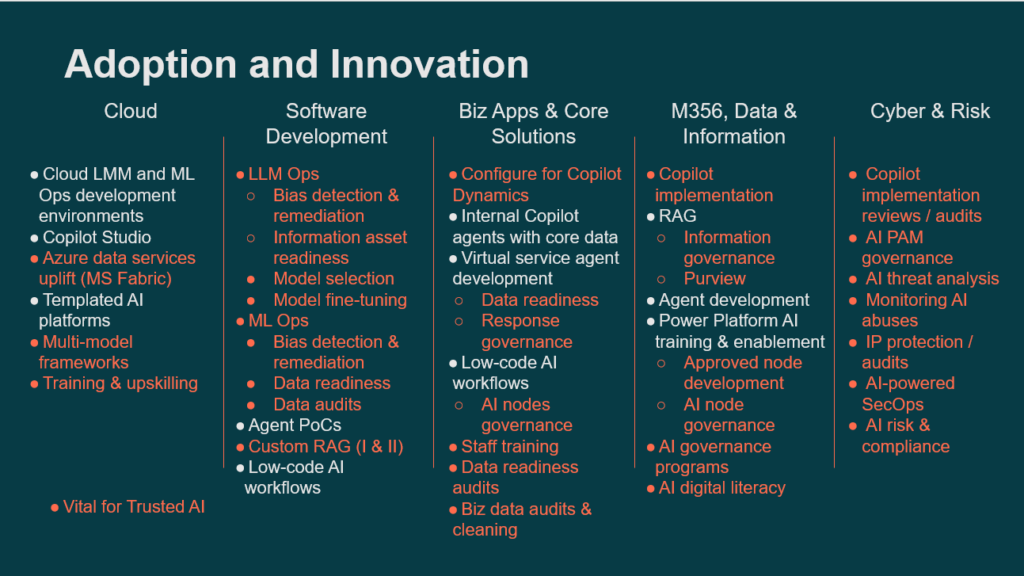
The matrix below was presented at a Crayon Connect partner summit event last year.
As with the table included for the pilot phase in the previous post, this also remains a sound guide on what comes into play during in the Copilot adoption stage. The extent to which this is true depends on your client’s business; size, maturity, industry and need – however what is included here is based on observable activity in the IBRS client base and from our own research findings.

The adoption phase moves proven pilot projects into wider deployment within the business. The focus is on expanding scope, refining integration, and ensuring users actually adopt the tools.
For partners, the emphasis shifts from pilot project delivery to creating measurable new capabilities, efficiencies, or innovations. During this phase, benefits should start to emerge, although they may still be uneven or limited to certain areas.
For customers, value in this phase is proven by bridging delivery to resulting benefits. If pilots are about proving the technology works, adoption is about confirming tangible operational improvements.
In short, adoption is about expanding usage and embedding AI into business process and culture — but it hasn’t yet become a business utility.
After a pilot, it’s not unusual to find businesses will still treat AI like an assistant they “ask” for help, rather than a system that can operate in the background to streamline work end-to-end.
The adoption phase is about embedding AI into the fabric of business operations so that it delivers results without users having to think about it. That means moving from occasional prompts to AI-driven processes that are consistent, repeatable, and measurable.
Embed AI directly into core systems like Dynamics 365, Business Central, or other business applications so that insights and recommendations appear where people already work.
Why: In-context AI saves time, reduces switching between apps, and increases adoption by making AI support feel seamless.
Develop reusable AI agents that automate routine decisions or surface relevant data at key points in a process.
Why: Reusable agents reduce project costs for customers and create repeatable service revenue for partners.
Use the Power Platform and Azure automation to link AI outputs to downstream actions — reducing the need for manual intervention.
Why: Connecting AI directly to action shortens process cycles and turns insights into measurable results.
In the next phase of adoption, the most effective AI deployments will combine multiple models, each performing specialised tasks in a coordinated way.
This “multimodal” approach can deliver more accurate insights, richer outputs, and greater business value than relying on one model alone. Partners have an opportunity to design these interconnected systems for SMB customers, ensuring each AI tool plays to its strengths.
Design multimodal AI architectures that make the most of Azure AI services, Copilot, and other specialist models.
Why: Multi-model designs combine strengths and minimise weaknesses, leading to more accurate and versatile AI-driven outcomes.
Map the right tools to each function from recommendation engines to generative summarisation, ensuring they operate as a coordinated system.
Why: Tool-to-task alignment avoids over-engineering and ensures each AI investment delivers targeted business value.
Provide reference architectures and best-practice deployment patterns for SMB-scale environments.
Why: Proven patterns reduce risk, speed up deployment, and give SMBs confidence in their AI roadmap.
Getting AI up and running is one thing. Keeping it tuned, relevant, and aligned to business objectives is another.
As adoption deepens, SMBs will need help managing AI like any other critical business system. This means defined processes for training, monitoring, and improving models over time, and is where where MLOps and LLMOps come in.
MLOps and LLMOps services to manage the lifecycle of AI models.
Why: Proactive management keeps AI relevant, secure, and delivering consistent performance over time.
Build consultative engagements that clarify what business value will be measured, not just model accuracy.
Why: Focusing on measurable value helps customers justify investment and prioritise projects that impact the bottom line.
Create feedback loops between AI outputs and business outcomes, ensuring continuous improvement.
Why: Closing the loop ensures AI learns from real-world performance and stays aligned with changing priorities.
In the pilot stage, the goal was to prepare data for AI to work at all. In the adoption stage, the challenge shifts to keeping data healthy — monitoring quality, ensuring relevance, and maintaining compliance. Data is no longer a “one and done” task; it becomes an ongoing discipline.
Provide data auditing services to monitor the health and reliability of data feeding AI systems.
Why: Poor data quality leads to poor AI outputs, undermining trust and adoption.
Implement Microsoft Purview to enforce data governance policies and control sensitive information.
Why: Governance safeguards compliance and ensures data is used responsibly and securely.
Deploy Retrieval-Augmented Generation (RAG) for secure, context-aware AI interactions with customer-approved datasets.
Why: RAG improves AI relevance and accuracy while keeping responses within trusted data boundaries.
Even the most advanced AI won’t deliver its full potential if employees don’t know how to use it — or can’t see where it could make a difference.
Cultural change is the unsung hero of AI adoption. Partners who help build AI literacy and foster innovation will drive deeper and more sustainable adoption.
Run experiential AI workshops where teams solve real business challenges using Copilot and related tools.
Why: Hands-on experience changes perceptions and builds confidence in using AI day-to-day.
Establish innovation programs that capture frontline ideas for new AI use cases.
Why: The best AI ideas often come from those closest to the work, not the IT team.
Create role-specific training to ensure adoption is relevant to daily work, not just a generic skillset.
Why: Tailored training increases relevance, speeds up adoption, and embeds AI into routine activities.
When AI is embedded across an organisation, governance is no longer optional. It becomes a critical framework for protecting data, ensuring compliance, and maintaining trust.
Partners can help customers establish these guardrails — and keep them effective over time.
Develop and implement AI governance frameworks that cover responsible use, ethical considerations, and regulatory compliance.
Why: Clear rules prevent misuse, reduce legal risk, and protect brand reputation.
Offer independent AI audits to verify that outputs remain accurate, secure, and aligned with policy.
Why: Independent checks build trust with customers, boards, and regulators.
Advise on privileged access management for AI tools, especially those handling sensitive or regulated data.
Why: Controlled access limits insider risk and protects critical business information.
As AI capabilities expand, so does the potential for misuse. Cybercriminals are already exploiting AI to automate attacks, create deepfakes, and weaponise stolen data. In the adoption stage, security needs to evolve in step with AI.
Deliver AI-powered cyber defence services capable of countering AI-enabled attacks.
Why: Defending AI with AI keeps pace with rapidly evolving threats.
Monitor for data leakage and IP misuse, including derivative content generation.
Why: Early detection of leaks prevents reputational damage and financial loss.
Integrate AI output monitoring into existing security operations to detect anomalies and non-compliant behaviour.
Why: Continuous monitoring ensures AI remains a safe, trusted part of business operations.
I’ve mentioned in previous posts that AI adoption isn’t a one-off project — it’s a kickstart on a journey of digital uplift for systems and process.
Partners who can bridge the gap between technology, process, and people will:
If you helped customers start their AI journey, you can help them turn it into a lasting competitive advantage. Success in the adoption phase can lead to AI becoming industrialised within a business, and I’ll be drilling into that in the next episode!
Dr. Sweeney is a principal advisor and industry analyst at IBRS. He is a recognised thought leader in Future of Work, digital innovation, workforce transformation, and organisational change strategy. His fields of expertise include Microsoft, Google, AWS, VMware and Citrix.

Press Release
Blogs
As cybersecurity and continuity converge in platforms and in practice, partners need new playbooks to address modern Data Protection standards. Our in-house cybersecurity pre-sales lead, Michael Brooke explains why.
Guides and eBooks
What triggers an SMB customer to begin exploring their need for better Data Protection? The first of our four Data Protection Playbooks for partners breaks down how to position and win in the Pre-Adoption and Exploration stage.
Insights
Data Protection priorities are shifting for SMBs. Ramp up your ability to respond with curated insights, articles and resources to help you guide every customer conversation with confidence.
Partner Spotlight
In this Partner Spotlight, Acceltech Managing Director Ivy Tarrobago shares how Crayon’s responsive support enhances client outcomes and business growth.
Whitepapers
Data Protection is a must for all SMBs but how can partners align solution investment with critical business objectives? Our latest paper shows you how.
Press Release
The full roll-out of Crayon's next generation Cloud-iQ platform has arrived, with enhanced features and functionality that partners will love.
Press Release
Crayon has been recognised with a huge double win at the CRN Channel Asia awards ceremony.
Insights
All the latest insights, articles and resources on M365 Copilot, curated into one place.
Insights
SMB customers are storing greater volumes of sensitive data in more places than ever. Secure backup and recovery practices are essential to how they protect it.
Partner Spotlight
Bigfish Technology saved AU$20,000 on its annual Microsoft licensing after one call with Crayon and has since built a strong partnership that enabled Bigfish to get access to Crayon’s expertise and vendor ecosystem.
Insights
Insider risk is a subtle and continuous challenge for SMB customers. Turn it into a manageable and quantifiable aspect of their Data Protection strategy.
Blogs
From rethinking backup to governance frameworks and behavioural analytics, what's involved in building a complete Data Protection strategy for SMB customers?
Case Studies
Find out how Dynamics Square combined Cloud ERP and Copilot to transform operations for a growing pharmaceutical manufacturer.
Case Studies
Explore how Dynamics Square delivered a 25% cost reduction for AV Health in our latest case study.
Case Studies
Learn how Navigatum reduced Azure infrastructure costs and delivered a cost-effective, scalable foundation for growth for a leading strata firm.
Guides and eBooks
Insights, articles and resources on major updates in Microsoft's programs and licensing agreements and channel strategy.
Insights
We explore the evolution of Microsoft's channel strategy over the past ten years, and what can be learned by viewing it through a Value Cycle lens.
Insights
Rhonda Robati, Executive Vice President of Crayon APAC assesses the factors driving Microsoft's channel strategy and the evolution needed to be a Partner of the Future.
Guides and eBooks
The Microsoft Fabric Partner Guide curates our recent articles, videos and resources to accelerate Crayon partner learning.
Insights
In the fourth of our six-part vlog series, Dr. Joseph Sweeney breaks down what can make - or break- a successful Gen AI pilot project.
Insights
In part three of our six-part vlog series, Dr. Joseph Sweeney maps out the service and solution opportunities for partners when preparing SMB customers for Copilot adoption.
Insights
To help our partners make sense of the tipping point between risk and reward with Gen AI, we've partnered with one of the region's leading advisors on the Future of Work, Dr. Joseph Sweeney. Part 1 of a 6-part vlog series.
Blogs
SMBs are on the hunt for intelligent, resilient and secure Field Service solutions. Explore a stack solution that meets all their needs!
Insights
SMBs in APAC are ramping up adoption of cloud-based business applications. Find out why and how this influences the services and capabilities sought from their trusted IT service partners.
Insights
SMB operations in the Asia Pacific region are shifting from traditional backup and disaster recovery toward something more transformative.
Insights
The latest in our Future of Operations insights series looks at why SMBs are pursuing hybrid cloud and multi-cloud strategies to achieve their business objectives.
Training
M365 Copilot implementations for customers should be viewed through a risk tolerance lens. Explore risk tolerance profiles and what they mean.
Insights
A recent study of small to medium sized businesses (SMBs) across the Asia Pacific region signals a sweet spot for partners that can connect Cloud ERP, Business Process Automation and AI.

Connect Data Protection to strategic objectives via this Whitepaper

What are the most critical business objectives and solution adoption priorities for SMBs in our region? Download the latest Forrester study to find out!

Our APAC channel business is now part of a global organisation. That means there is a whole new world of value on offer for our partners. We can help you to tap into all of it.